


Fully Threaded Rods / Studs for Corrosive Environments
Product Overview
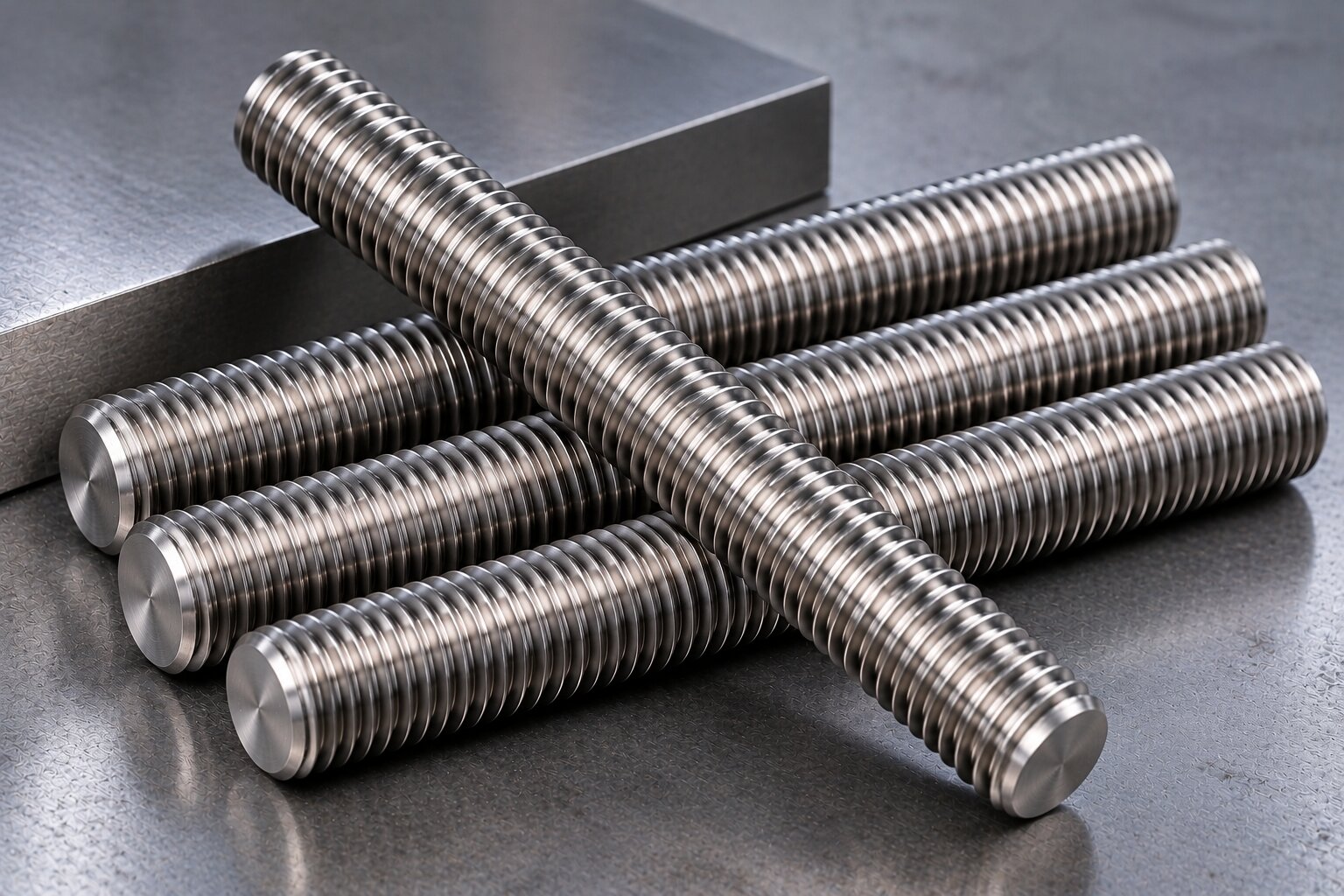
Fully threaded rods and studs provide continuous threads along their usable length for flexible nut positioning and secure assembly. Material options include carbon steel, stainless steel, alloy steel, nickel alloys and titanium for different strength, corrosion and temperature requirements.
In addition, buyers can specify the rod diameter, overall length, thread pitch, thread class, material grade and end condition. Therefore, each threaded rod or stud should match the load, mating components, temperature and chemical environment.
Materials, Grades & Thread Configurations
Material options vary according to engineering and environmental requirements. Moreover, selection should consider the application, service conditions and the applicable technical specification.
Common Fully Threaded Rod / Stud Options
Carbon Steel
For construction, machinery and general industrial fastening, carbon steel provides economical strength and broad availability.
Stainless Steel
Where corrosion resistance, hygiene or outdoor exposure matters, stainless steel provides durable fastening in multiple grades.
Metric Thread Forms
Metric coarse and fine threads are available according to the required diameter, pitch, tolerance and project specification.
UNC & UNF Thread Forms
In addition, UNC and UNF thread forms can be supplied for inch-based assemblies and specified mating components.
Custom Lengths & End Details
Meanwhile, custom lengths and end details can include chamfers, points, slots, flats, drilled holes or drawing-defined features.
Custom & Special Grades
Finally, buyers can request special diameters, lengths, pitches, thread classes, grades and packaging.
Fully Threaded Rod / Stud Specifications
Dimensions, materials, grades and applicable standards can be selected according to the project drawing or purchase specification. Therefore, the final configuration should match the required service conditions.
For general fastener material, testing and performance information, refer to ASTM fastener standards.
Key Specification Parameters
| Parameter | Available Options |
|---|---|
| Product Type | Fully threaded rods and studs with continuous external threads |
| Material Grades | Carbon steel, stainless steel, alloy steel, nickel alloys, titanium and specified grades |
| Configurations | Full-length threads, cut-to-length pieces and drawing-specific details |
| Thread Types | Metric coarse/fine, UNC, UNF and specified thread forms |
| Dimensions | Standard and custom diameters, overall lengths, pitches and thread classes |
| Ends | Chamfered, pointed, flat, slotted, drilled or drawing-defined end details |
| Surface Condition | Cleaned, solution-treated condition as supplied, or project-specified finish |
| Supply | Full rods, cut lengths, individual studs, matched nuts and washers, or project assemblies |
| Inspection | Material verification, dimensions, thread fit, straightness and documentation |
Fully Threaded Rod / Stud Applications
Engineers specify these fully threaded rods and studs for chemical plants, pollution-control equipment, marine systems, oil and gas facilities and heat exchangers. For example, suitable grades secure flanges, supports, vessels, reactors and corrosive process equipment.
Typical Use Areas
Fully Threaded Rod / Stud Manufacturing
Generally, the production route depends on the selected material grade, rod diameter, overall length, thread form and end details. In practice, manufacturing includes material verification, cutting, thread rolling or machining, cleaning, finishing and inspection. In addition, teams control each stage against the drawing or purchase requirement.
Typical Production Stages
Raw Material Verification
First, the production team verifies the specified material grade, bar dimensions, heat number and incoming material condition.
Forming & Machining
Next, controlled cutting prepares the required rod length, end geometry and any drawing-defined features.
Threading & Passivation
Afterward, continuous threads are rolled or machined to the specified form and class. Moreover, rods are cleaned and finished as required.
Inspection
Finally, inspection verifies dimensions, thread fit, straightness, material identity, surface condition and documentation.
Quality & Inspection
Inspection Areas
Consistent Product Requirements
Related Fully Threaded Rods / Studs
Fully Threaded Rod / Stud FAQs
What is a Fully threaded rod or stud?
A fully threaded rod or stud has continuous external threads along its usable length. Available in multiple materials and grades, it supports flexible nut positioning and reliable fastening in varied assemblies.
Which thread forms and grades are available?
Common options include metric coarse or fine, UNC, UNF and custom threads in carbon steel, stainless steel, alloy steel, nickel alloys and titanium. However, availability depends on diameter, length, thread form, grade and quantity.
Can these studs be customized?
Buyers can discuss custom diameters, lengths, thread forms, end details, grades and packaging according to the specification. Moreover, final requirements should be confirmed before production.
Where are fully threaded rods and studs used?
Engineers commonly specify these studs for chemical plants, marine systems, oil and gas equipment, heat exchangers and pollution-control systems. For example, the selected grade should match the media, temperature and load.
How do I select the correct stud?
Selection should consider material and grade, diameter, length, thread form, load, temperature, chemicals and mating components. Therefore, buyers should review project calculations and material requirements before ordering.
Looking for Fully Threaded Rods / Studs?
Finally, share the required material and grade, diameter, length, thread form, quantity and project specification with our team.