


Fastener Retention for Industrial Assemblies
Product Overview
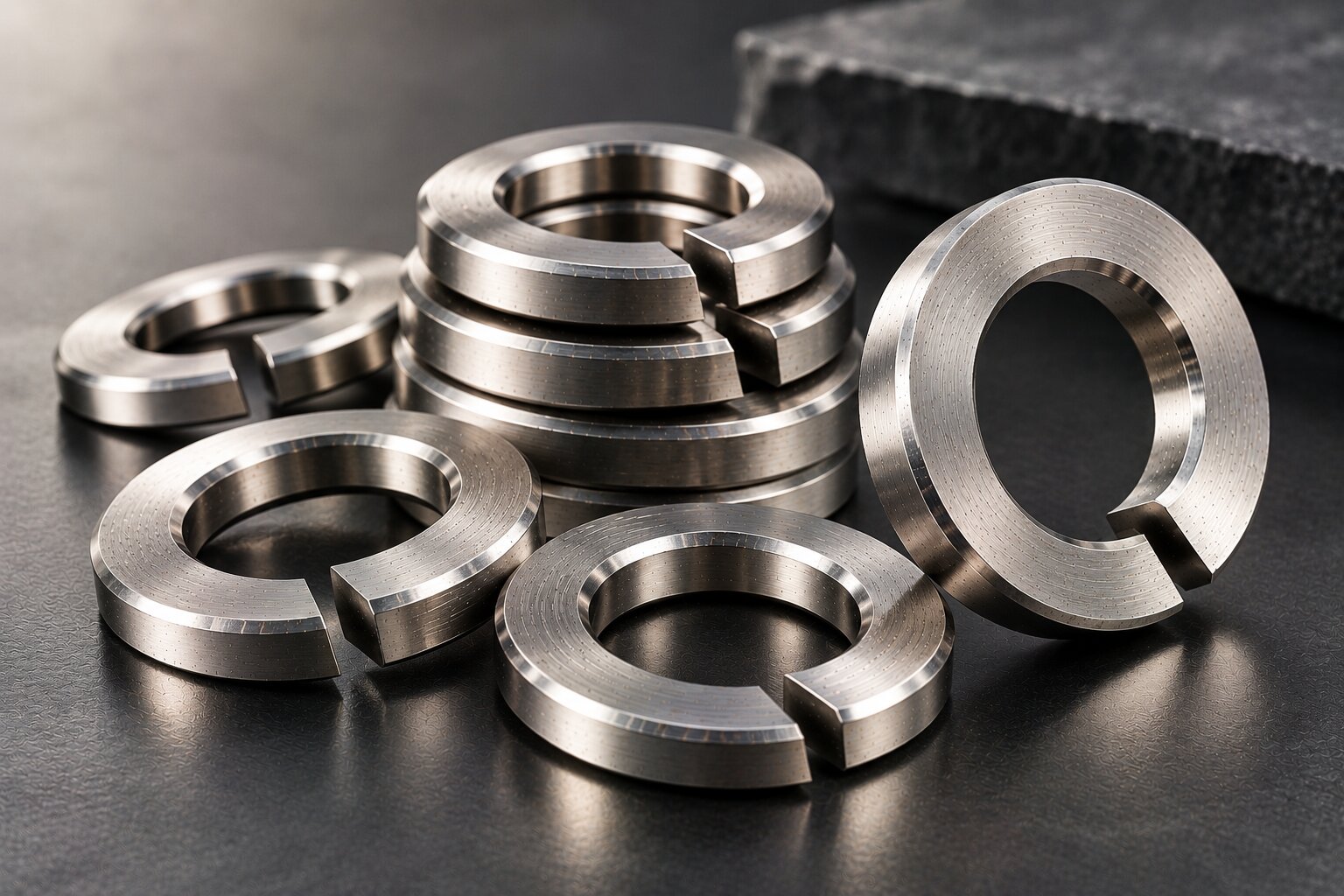
In practice, the Lock Washer creates spring tension, tooth contact or a formed profile that helps resist rotation and loosening in industrial assemblies. Moreover, multiple material and finish options support corrosive, high-temperature and general engineering service.
In addition, buyers can specify the nominal fastener size, inside diameter, outside diameter, thickness, free height, locking style and material. Therefore, each washer can be matched to the joint, vibration level, temperature and environment.
Lock Washer Materials & Configurations
Material options vary according to engineering and environmental requirements. Moreover, selection should consider the application, service conditions and the applicable technical specification.
Common Product Options
Carbon & Alloy Steel
For construction, machinery and general engineering, carbon and alloy steel provide economical strength plus multiple coating and hardness options.
Stainless & Non-Ferrous Alloys
Where corrosion resistance, low weight or conductivity is required, stainless steel, brass, titanium, nickel and special alloys are available.
Split Lock Washer
Helical split designs develop spring tension under compression and help resist rotational loosening in compatible bolted joints.
Internal & External Tooth
In addition, internal-tooth and external-tooth designs can provide biting contact for specified fasteners and assembly surfaces.
Wave & Special Designs
Meanwhile, wave, conical and drawing-defined profiles can support preload control and special locking requirements.
Custom & Special Grades
Finally, buyers can request special sizes, locking profiles, free heights, materials, finishes and packaging.
Lock Washer Specifications
Additionally, dimensions, materials, grades and applicable standards can be selected according to the project drawing or purchase specification. Therefore, the final configuration should match the required service conditions.
For dimensional requirements and test methods for helical spring-lock and tooth-lock designs, refer to the ASME B18.21.1 washer standard.
Key Specification Parameters
| Parameter | Available Options |
|---|---|
| Product Type | Split, internal-tooth, external-tooth, wave and custom locking washer |
| Materials | Carbon steel, alloy steel, stainless steel, brass, titanium, nickel, Monel, Inconel and Hastelloy |
| Dimensions | Nominal fastener size, ID, OD, thickness, free height and profile geometry |
| Standards | DIN 127, DIN 6797, DIN 6798, ASME B18.21.1 or custom drawing, as applicable |
| Tolerances | Specified ID, OD, thickness, free height and locking-profile tolerances |
| Profiles | Helical split, internal tooth, external tooth, wave or drawing-defined |
| Surface Condition | Plain, polished, passivated, black oxide, phosphate, zinc-coated or project-specified finish |
| Supply | Individual pieces, bulk quantities, kits or project-specific packaging |
| Inspection | Material verification, dimensions, free height, locking profile, surface and documentation |
Lock Washer Applications
Consequently, engineers specify this locking washer for construction, automotive systems, marine equipment, machinery, electronics and general fabrication. For example, a suitable design helps retain fasteners on frames, supports and equipment exposed to vibration or thermal cycling.
Typical Use Areas
Manufacturing Process
Generally, the production route depends on the selected material, nominal size, thickness and locking profile. In practice, manufacturing includes material verification, blanking, forming, heat treatment where applicable, cleaning and inspection. In addition, teams control each stage against the drawing or purchase requirement.
Typical Production Stages
Raw Material Verification
First, the production team verifies the specified material grade, sheet or strip dimensions, heat number and incoming condition.
Forming & Machining
Next, controlled blanking produces the required inside diameter, outside diameter and initial washer geometry.
Deburring & Finishing
Afterward, split, tooth, wave or custom locking features are formed before the surfaces are cleaned and finished.
Inspection
Finally, inspection verifies dimensions, free height, locking profile, material identity, surface condition and documentation.
Quality & Inspection
Inspection Areas
Consistent Product Requirements
Related Material Options
Product FAQs
What is a Lock washer?
A lock washer uses spring tension, teeth or a formed profile to help resist fastener rotation. Produced from the selected material, it supports dependable locking performance for the specified environment.
Which grades are available?
Common options include carbon steel, alloy steel, stainless steel, brass, titanium and nickel alloys. However, availability depends on nominal size, locking style, thickness, finish and quantity.
Can this washer be customized?
Buyers can discuss custom sizes, split or tooth profiles, thicknesses, free heights, grades and packaging according to the specification. Moreover, final requirements should be confirmed before production.
Where is a lock washer used?
Engineers commonly specify this washer for chemical plants, marine systems, oil and gas equipment, heat exchangers and pollution-control systems. For example, the selected grade should match the media, temperature and load.
How do I select the correct washer?
Selection should consider the material, nominal size, locking style, preload, vibration, temperature and environment. Therefore, buyers should review joint requirements before ordering.
Looking for Lock Washer?
Finally, share the required material, nominal size, locking style, thickness, quantity and project specification with our team.